I heard the voice of Jesus say,
“I am this dark world's Light;
Look unto Me, thy morn shall rise,
And all thy day be bright.”
I looked to Jesus, and I found
In Him my Star, my Sun;
And in that Light of life I'll walk
Till trav'lling days are done.”
Family Origins
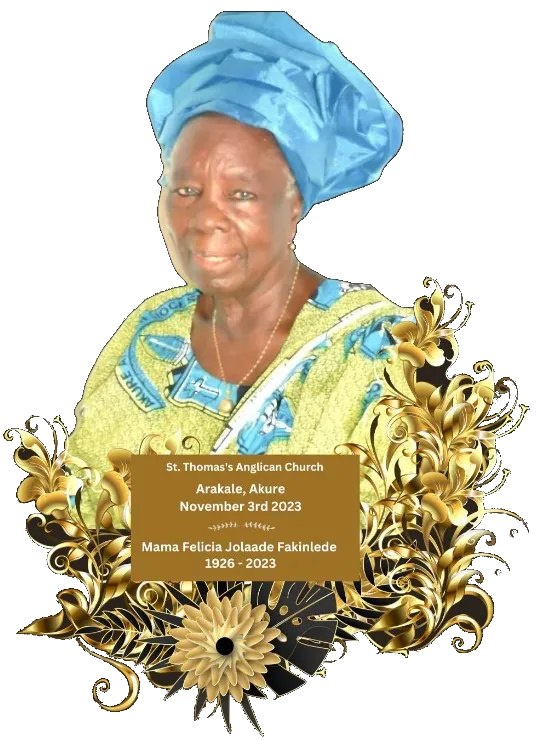
Jolaade Arigho Ojo-Ologun was born at Akure on March 25, 1926. Her father, Ojo Ologun, was a descendant of Bini warriors that garrisoned in Akure until 1897 when the British sack of Benin empire emboldened the vassal regime in Akure to fully rebel against Benin overlordship. The erstwhile warriors and lords thenceforth became stranded in Akure as majority of them had intermarried and had transmogrified to a distinct faction now known as Ado-Akure. The word “Ado” here should not be confused with the town called Ado Ekiti. Rather, Ado here, pronounced just like the “Edo” alternative name of Benin people, is the Akure word for Bini.
Ojo, her father, was initially an itinerant trader that went as far as Ilorin – on foot,
to buy, sell and move his wares. These traders travelled in companies and were usually armed
to protect themselves from thieves and other hazards on such long trade routes. By the time
mama Jolaade was born, Ojo-Ologun had become a Roman Catholic and had settled down as a
successful cocoa farmer in Ogbese, on the way between Akure and Owo. He surrounded himself
with relatives and friends. Cocoa trade was good, and his success was measurable as one of the
first people to own a motor vehicle in Akure.
Her mother, Omomo-Ojo-Ologun, was the youngest of siblings fleeing Effon Alaiye in
Ijeshaland during the several wars and slave raids of that era. At Akure, she was married to
Ojo-Ologun as his first wife. That marriage produced the following children that survived to
adulthood: Osasogie (called Shasoge in Akure), Ajari (Eye Jimoh), Omolagba (Omoruyi), Jolaade
(Arigho), Imatitikhua (Titi), Mary and Abiye. Ojo-Ologun had children from four other wives.
Ologun’s wealth in material goods did not instruct him to educate his children. There
was no immediate correlation between success and the new idea of “Western” education. He
therefore educated neither male nor female initially. The earliest of the children that had
any formal education came after mama Jolaade. None of his children preceded his grandchildren
to high school. His cousin, Peter Eke, was a trained surveyor and his neighbor at the Igisan
quarters. Jolaade’s accurate birthdate was due to diligent record-keeping by this sole
educated member of the family.
Early Life
Jolaade, the teenager, like her father before her, began itinerant trading as soon as
she was old enough to do so. Trading with neighboring towns such as Ado-Ekiti, Owo, etc, with
traders, as was the practice, going on foot and carrying their wares on their heads was the
mainstay at that time. Mother told me she was quite grown up and successful in trade by the
time she became Papa Isaac Fakinlede’s fourth wife! Interestingly, records show she was only
seventeen at that time! Papa Isaac Fakinlede, his brother Fayanju (Uke) with their wives and
families, continued to live with their parents on Arakale road, until 1950 when he moved his
family to the present family house on Oyemekun Road. Relative prosperity at that time showed
up in their ability to build a storey building (petesi) and having much more room than they
could use. As the house was close to the government’s Public Works Department (PWD) yard,
there was sufficient room to add a number of paying tenants to the large family house. Mama
Jolaade built her shop in front of the building and traded in small wares as well as ran a
’buka’ for the workers of the PWD. The older children attended school at St Thomas’ Primary
School – close to the original family dwelling while younger children, beginning from Coli,
went to St Theresa’s as it was closer to the new family house.
Struggles and Hardships
Jolaade’s life was heavily affected by two major issues of life: The second child, a
male called Ayo and the third, - a daughter called Womiloju. Ayo’s neurological challenge
reduced the ability of mama Jolaade to move around since his problems increased to the extent
that he could not remain in school and had to be taken care of at home. She was unable to cope
till her mother, Omomo Ojo-Ologun relieved her and caused Ayo to live with her. That temporary
respite gave mama Jolaade the time to increase her trade and she was reasonably successful.
Apart from selling provisions and cooked food, she also went into brewing the local barley
beer (burukutu) and later went into the clothes dyeing business.
Her life changed again with the tumultuous incident of Womiloju’s death at 18. Ayo
returned home after grandma Omomo died in 1980. It was a life of toil and hard work to assist
father to keep us in school, with her first son in the university beginning from 1966. Things
changed for the better in 1970 with Olubodun’s graduation from university and there was a
respite as school fees were no longer such a tough challenge for her.
Travelling Days
Mama’s travelling days included a heavy dose of churching for herself and the children
– just like everyone in the Fakinlede’s household. Sunday mornings were memorable. There was
this elaborate dressing and make-up with “tiro” eyelashes and “papanlolo” for the face after
everyone had a good bath. Everyone walked to church in our house. Even baba with his two
vehicles (a Raleigh and a Rudge bicycles), parked them and had that early morning walk to go
and pray “Ki Oluwa ki o pelu nyin, ki O si pelu emi re, E je ki a gbadura …”. Synod report,
end of year bible drama, etc. The church also encouraged membership of groups and Sunday
afternoons were elaborate age grade meetings (mitini egbe) and children waited for the rice
mama would return home with from the ‘mitini’!
Mama Jolaade’s travelling days began with being born into the relative wealth of the
successful cocoa farmer and this showed up in her Bini name “Arigho” literally meaning “We eat
money”! Starting out with teen itinerant trading and married off at 17. Bearing nine children
and burying five of them: three at the common childhood morbidity prevalent in the 19day, and
two in tragic adulthood. She soldiered on, looking after these children in the new era of
costly education. The education of those days began, for some of us, as “Free Primary”
education. Our parents took advantage of this and the location of several “Mission Schools” in
proximity of our home, with father’s great encouragement, meant every capable child could
attend.
By the time you reached secondary school, it became a bit more expensive. Small-time
traders, like my father, could not afford the fees for the large number of children he had,
but he too soldiered on encouraged by our mothers who would not take staying at home as an
option for any child. Jolaade stayed the course with all her children no matter what the
obstacles were. If there was any partiality, it was by staying with the weakest until they
mended!
Wednesday, September 13, I got a call that mama was having a serious pain at the back. I
promised to be there the next morning. Many calls later, we appeared to be in the clear. Mama
woke up on Thursday, had her bath and requested a specific breakfast that was promptly made by
my sister, Abegbe.
Thirty minutes later, mama had stopped breathing: Travelling days were over! The strife
of life was over, the battle won. May we continue to sing the songs of triumph. Amen!